|
 |
 |
 |

|

|
 |
 |
 |
 |
 |
 |
 |
 |
 |
|
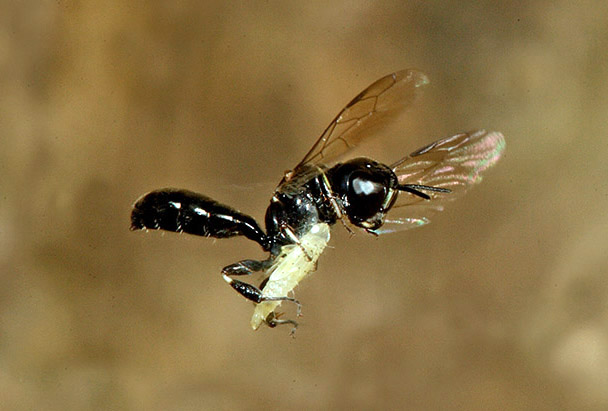
Even with modern improvements such as lightning-fast auto-focusing and motor drives capable of firing the camera shutter ten times a second, plus digital memory cards that can store 40 times as many images as the old-style individual 36-frame films, photographing aculeates in flight remains a complicated affair. They are not the fastest invertebrate fliers, with some Diptera and Odonata travelling much quicker. One Australian dragonfly reportedly has been 'clocked' at 36mph whereas 15-20mph would be a maximum for most bees or wasps. Also, speeds vary depending on individual species, with larger ones tending to fly faster due to their greater mass, and on what they happen to be doing. For example, the rate of progress when foraging is usually relatively low, and for obvious reasons - extra weight and wind resistance - headway is slower when returning to a nest than when leaving it. Our largest aculeate, the Hornet (Vespa crabro), uses between 117 and 247 wingbeats The studio approach has never had any appeal to me, since many of the resulting images tend to show a wasp or bee in flight, but not much more. From a purely aesthetic point of view, with the wings completely frozen at high speed, say 1/25,000th second, there is no genuine sensation of movement actually occurring. But forgetting this, and acknowledging that the technical marvel that is flight is indeed shown in all its glory in many studio images, there is still a major drawback. Put simply, nothing is ever being carried in the legs or mandibles of any wasp pictured in a studio, or in the mandibles or on the scopae of any bee. In other words, there is little characteristic behaviour on offer. Additionally, photographs taken in studios, and especially inside flight tunnels, quite often seem to have a backdrop which in colouration is not entirely natural. To photograph an aculeate doing something in flight besides merely moving The first rule is to capture any female stocking a nest in a suitable position, in order to identify her before attempting action photography. Taking images, whether it is of interesting behaviour or not, is of questionable value without knowing what the species is. None of the aculeates I have photographed (or tried to photograph) in flight at nests have been difficult to determine. They are Ancistrocerus nigricornis, Odynerus spinipes, Psenulus pallipes, Crabro scutellatus, Ectemnius cavifrons, Ectemnius cephalotes, Rhopalum clavipes, Crossocerus annulipes, Crossocerus megacephalus, Trypoxylon clavicerum, Mellinus arvensis, Cerceris arenaria, Cerceris quinquefasciata, Cerceris rybyensis, Philanthus triangulum, Colletes hederae, Andrena cineraria, Andrena fulva, Dasypoda hirtipes, Megachile ligniseca, Anthophora plumipes, Ceratina cyanea, Osmia rufa, Heriades truncorum and Bombus lapidarius plus the cleptoparasites Nomada fucata and Nomada signata. 
Nomada bees are among the slowest fliers in the family, and often fly close to the ground, both of which tendencies are helpful, though their small size is not a boon. Some bees gathering pollen can end up providing an in-flight shot almost by accident, because they flit from bloom to bloom. This particularly applies to Colletes succinctus and Lasioglossum prasinum, which use Heather as their pollen source. The flowers are tiny, so constant movement is required. For anyone wishing to try and obtain images of bees in flight, flowers are the best bet and bumblebees are among the easiest options. Bombus muscorum is one of the species I have managed to photograph in this way. Some wasps are good on flowers too as they take nectar or look for prey. The former include Ancistrocerus gazella and Ancistrocerus nigricornis, with Canadian Goldenrod a classic plant, and Argogorytes mystaceus, while Cerceris rybyensis is regularly seen around Common Ragwort looking for bee prey. My standard equipment is a Canon 1D Mark II digital camera, which on motor drive takes eight frames a second, with a 100mm or 180mm macro lens, 12mm extension ring and Canon Macro Twinlite MT-24EX flash unit set manually on 1/32nd power. The close focus on the 100m lens offers a field of view of only 24mm x 16mm, and on ISO 200 at f16 at 1/250th second Fossorial species that fly with prey or pollen are among the toughest to try and photograph near the nest, even when they are fairly large such as Crabro species, Cerceris species, some Andrena species or the Hairy-legged Mining Bee (Dasypoda hirtipes). Placing the camera on the ground pre-focussed on a point above the burrow rarely works since the bees do not all fly straight in - Andrena cineraria is a fair-sized one that usually does - and the wasps rarely fly in at the same angle. Moreover, providing the prey is not too large they tend to enter at pretty high speeds. Crabro scutellatus is the fastest I have seen, but Cerceris arenaria is not far behind. One species that does not go at a breathtaking pace is Size of prey can be a crucial consideration but even though some of the solitary bee prey caught by Cerceris rybyensis are pretty substantial I have never managed to obtain an image of the process, just a female on her own in 2007. My only successes with Cerceris quinquefasciata in flight occurred that same year when a female caught presumed Sitona lineatus weevils, which were too large to allow her to go straight into her burrow at speed, instead forcing her to land gently close by and quickly walk in. In the same vein, the Beekiller Wasp (Philanthus triangulum) is not always too demanding since the nests sometimes As a point of interest, Philanthus triangulum was one of a dozen species of wasp, mostly fossorial and also including Mimesa equestris and Lindenius pygmaeus, successfully photographed in flight with prey in the late 1950s by Gunter Olberg, probably the finest photographer of wasps there has ever been and a splendid naturalist to boot. Despite this, aerial nesters on the whole offer much better opportunities for in-flight photography than those using the soil since suitable places to build nests can be provided readily in a relatively controlled though still wild environment - the garden.
My first attempts at this were in 2005 at a friend's cottage in the Cotswolds where a number of Anthophora plumipes and Osmia rufa nested in the walls. The former in particular is a large species and one that doesn't fly excessively fast, allowing enough scope for some reasonable results using only an early digital camera, a Canon EOS 10D, with its on-board flash and handheld to boot. Tripods make life much easier though. Setting them up and leaving them with one or more cameras carefully focused manually on the likely path an aculeate may use is feasible on private property but unthinkable in locations open to the public. My first successful use of a tripod for a small species was in 2007 on logs in my garden at Reigate. The wasp was Rhopalum clavipes, measuring 7mm, and while the results left room for improvement in terms of sharpness they were acceptable. With recording for the book Wasps of Surrey just about complete and no more images required for that publication, I decided to make 2010 a year in which to concentrate on in-flight images and the results were reasonably satisfactory. I purchased three boxes, one made by the Oxford Bee Company and two by the German company Schwegler. All three provided fairly large, flat faces, which made it relatively easy to place photographic equipment on the same plane The species using the Oxford Bee Company box were, predictably, the Red Mason Bee (Osmia rufa) and, less expected, the Eumenid wasp Ancistrocerus nigricornis. Through May and into June several female Osmia rufa nested, completing nine burrows, but just one Ancistrocerus nigricornis was involved, with four burrows stocked over five days containing an average of six micromoth caterpillars in each of three cells. On the face of it, given the number of times the female bees and the wasp had to bring materials into their nests the opportunities for obtaining images were prolific. However, the fact that none of the subjects necessarily flew to the correct burrow complicated matters - the Osmia rufa in particular sometimes seemed clueless about where they were going, including twice entering the wasp's current burrow and ending up in a noisy dispute with the resident. Ancistrocerus nigricornis also did not go straight to the correct burrow every time. Using two cameras mounted on tripods on either side of the bee box and sitting close by The vast majority of the results, obtained over a fortnight or so, were of little account, especially as the angle of approach was often wrong and my judgment of when to fire the cameras was not always 100% either. An obvious problem is that unless the wings happen to be above the abdomen there is a strong likelihood that a crucial aspect, be it face, pollen brush or prey, may be obscured. There were enough satisfactory results though to encourage me to continue with species using the other two boxes from mid-June onwards. One interesting observation was that Ancistrocerus nigricornis closed the nest with a much smoother finish than Osmia rufa, whose work was relatively uneven.
At those boxes there was room for just one tripod. Heriades truncorum was the main focus of attention and provided plenty of good results from hundreds of attempts, though neither of the females approached the nest in a straight line more than a fraction of the time, often landing a few centimetres away and walking to the burrow. The Psenulus pallipes and Trypoxylon clavicerum, which also nested in the cut reeds from July onwards, are no larger than Heriades truncorum but proved slightly easier to photograph, since both usually went in at right angles to the nest at something less than full pace. Only one Psenulus pallipes was involved, completing two burrows - I ascertained that the second nest was being stocked by the same female by briefly blocking the entrance soon after she commenced operations on it, whereupon without hesitation she went unerringly to the first nest site. In full flow she took one prey item about every five minutes and as a bonus every so often she hovered momentarily in front of her nest before going in. Trypoxylon clavicerum was, or were since four burrows were completed, less speedy, averaging one spider caught every 20 minutes. The spiders, which were not from the same species, were all fully legged, with no amputation having occurred. Like Ancistrocerus nigricornis, but unlike all the other wasps I have seen flying to a nest, the Trypoxylon clavicerum used her mandibles to help grasp her prey en route and on one occasion she had the spider By late August the boxes were no longer being stocked by any species but several beech logs I had positioned vertically close by in 2008 were. The same principles applied in taking photographs. The principal nester was Pemphredon lugubris, which in my experience only rarely flies straight into the burrow. Other species included Crossocerus megacephalus, which I managed to photograph a few times as she flew towards her burrow but in only average fashion owing to her speed. Unfortunately not once did she have prey. Better opportunities were presented by Crossocerus annulipes and Ectemnius cavifrons. The former is small, only 6mm-7mm in length, and usually flies in with its bug prey much too fast to be caught properly on camera at a mere 1/250th second. However, a stroke of luck saw one of the six or so females of the species using the wood construct her nest, rather oddly, in the top of one of the logs rather than in the side. This meant that she was unable to fly in at right angles and had to slow down ever so slightly and adjust her flight path when close to the nest, giving a fraction of a second to take an image. Since she was catching up to 18 bugs a minute at the height of her activity she provided me with every chance but it still proved extremely difficult. As with so many other of the subjects of this venture, the Crossocerus annulipes could come in from any angle with her prey, and the fact that the two Ectemnius cavifrons This knowledge stood me in good stead with Ectemnius cavifrons in 2010, which was particularly gratifying given the brightness of the wasp's markings and of many of its hoverfly prey. Over the space of ten days in September 2010 I probably spent 20 hours watching and photographing the two females, using the equipment outlined above and one tripod. Unlike the smaller black species they could be seen coming towards the nests, which helped considerably in preventing my missing shots. In passing, capturing an image of either female leaving her nest was much harder work than may be imagined. Without the encumbrance of prey, both exited very fast and hardly ever at right angles to the nest. The picture below was the only success story here. The same comment holds good for the other species photographed during 2010, especially Heriades truncorum, which sometimes flew straight out though usually upwards or downwards, and often walked for a centimetre or two before launching herself into space. Be that as it may, the results with Ectemnius cavifrons justified the effort and, if anything, fired me to try even harder in future years.
As a postscript, the heavy snowfall of December 2010, pictured above right, left the boxes where so much of my photography just a few months earlier had taken place looking as if life within would be out of the question. It is part of the joy of studying nature, though, that species can cope with such conditions and emerge the following spring or summer as flying adults to continue the process. Images © Jeremy Early. All rights reserved. |